Tags:
 Film: The Invisible Half
Year: 2025
Director: Masaki Nishiyama
Writer: Masaki Nishiyama
Starring: Lisa Siera, Miyu Okuno and Runa Hirasawa
Review:
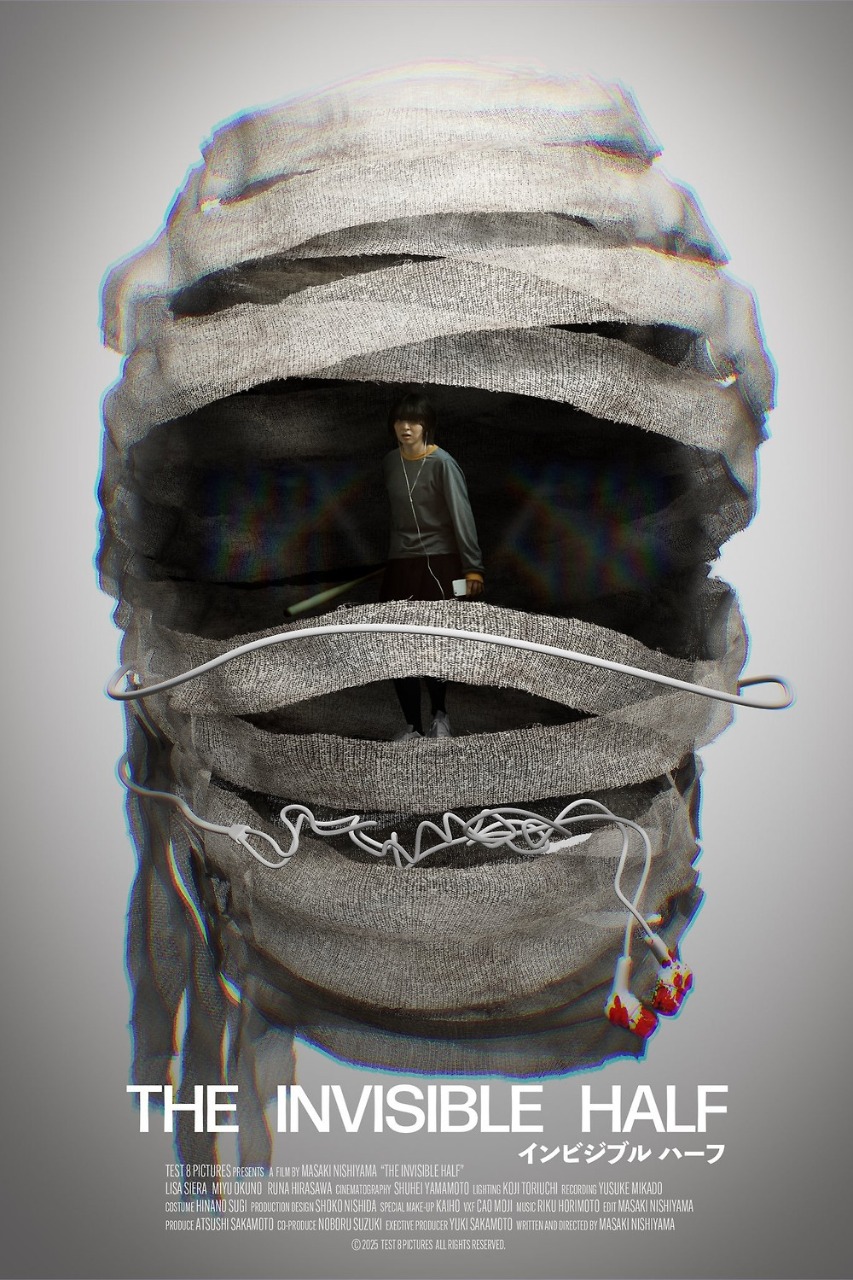
This was a film that I got the chance to see via screener from the Raindance Film Festival. It made its world premiere there. Now I tend to just confirm that movies like this are in this genre. From there, I did see the poster which caught my interest. This also being from Japan also helps to give me more of a world perspective for my end of year list. I’ve also now given it a second watch to see how I sat with it.
Synopsis: Elena (Lisa Siera), a “half” Japanese high school girl, struggles with her identity. While constantly watching, she discovers she’s also being watched by something else—a monster that can only be seen through her smartphone and heard through her earphones.
We start this with someone lying on the ground. This turns out to be Elena. We then see her in the hospital. Her mother comes in and scolds her. Elena is struggling with bullies. She lives in Japan with her mother. She is part British so she’s dealing with identity issues. Her mother is moving to a new school.
She comes into her new class room and sits next to Akari Yamamoto (Miyu Okuno). She loves the fact that Elena is part British. This leads her to asking different questions where Elena is uncomfortable. There is that glimmer that she has a potential friend. This school has these two mean girls. They start to bully Elena when she runs too hard during gym class. They also refer to her as a gaijin, which means ‘foreigner’ or outsider. There is another classmate that they target worse.
This would be Nyan Ito (Runa Hirasawa). She comes into class late when we first meet her. She’s wearing a mask and has earbuds in. The teacher calls out to her, asking her to remove them. She ignores the request. Akari fills in Elena about a rumor that her parents wanted a cat and that they named her how they did because of it. Elena feels bad for her.
There is an event that changes the lives of everyone forever. Mean girls hide Nyan's phone in Elena's bag, causing her to panic and leave school, leading to an incident. Police investigate. Elena finds the cracked phone that night, cutting her fingers. She then experiences a vivid nightmare featuring mean girls with dog heads, a dark Nyan, and cryptic warnings on a chalkboard.
Nyan seemed to believe she was followed by a dark entity. Elena hears heavy footsteps behind her when she’s walking. She takes her earbuds out and can no longer hear them. She puts them back in. The sound is there again. Elena then sees a figure, following her. Its face is wrapped up in bandages. She isn’t sure if it's real. That is until it attacks one of the mean girls. Elena is terrified and starts to act like Nyan did. Akari wants to help, but she’s pushed away. Elena must figure out what is after her before she meets a similar fate.
That is where I’ll leave my recap and introduction to the characters. While not an expert in Japanese cinema, I enjoyed j-horror from the 2000s and see its influence here, though Western horror also plays a part. The film effectively uses technology, a common theme in Japanese horror like Ringu, One Missed Call, and Pulse, offering commentary relevant to today's teens. This provides a strong foundation for further development.
Now that I have that done, let’s start with that last point. I have limited interactions with youth, tending to be only ones who are related to me or would be around them. I do know there’s a commentary here on how younger people often wear earbuds. In this case, it isn’t just for entertainment, but to hear an entity audible only through a smartphone connected to an earpiece. This creates tension when adults tell them to remove them, a potentially fatal risk in a horror film. It is playing with the idea of respecting elders, especially when asked to do something.
I think then I’ll shift slightly and bring up technology. J-horror films, like Ringu and One Missed Call, have previously incorporated cell phones, especially for videos and voicemails respectively. While a smartphone isn't explicitly necessary, their ubiquity makes them the likely choice. This device becomes a source of tension when Elena's mother, upset by her daughter's phone use, cracks the screen. This incident foreshadows potential danger for her daughter, a classic trope where a parent's disbelief inadvertently imperils their child.
Let’s then discuss the entity a bit here. Elena dreams of the figure, but it could also possibly be a darker reality. This adds an interesting element where she questions her sanity, a connection with Nyan. Elena believes it's Nyan, who disappeared, but that’s an assumption. The entity looks like a mummy with bandages. This entity, similar to the one in It Follows but appearing close by, builds tension despite an inconsistency where it goes stretches with staying away.
There is then one last theme to delve into and that would be with identity. Elena, bullied for her mixed heritage, moves to a new school. What she deals with mirrors the immigrant struggle to balance heritage and assimilation, often leading to criticism from both cultures. Elena befriends Akari, who is fascinated by British culture, finding it makes Elena more interesting. However, Akari's own insecurities about others' opinions create friction and doubt in their friendship. The title also is an element of this commentary.
Where I think I’ll then go into would be the acting performances. Siera, seemingly of Japanese and British descent, portrays Elena stoically, conveying depression and alienation. Okuno's portrayal as Elena's supportive friend is strong, though Elena still experiences hurt. Hirasawa's bullied character, Nyan, effectively foreshadows Elena's struggles. The remaining cast members adequately support the main characters' development.
All that is left then would be with filmmaking. The cinematography, framing, and sound design were excellent. The film uses surreal, nightmare-like sequences and long shots to create a creepy atmosphere, particularly with a watching figure. Only Elena and Nyan can initially see it, with Akari also experiencing its effects later. The muffled sound when Elena wears earbuds enhances the perspective and atmosphere. Overall, the film is well-made.
In conclusion, this is a thoughtfully crafted horror film that skillfully blends elements of j-horror with contemporary social commentary. Director Masaki Nishiyama effectively utilizes technology as both a plot device and a thematic tool, echoing classic Japanese horror while addressing the challenges faced by today's youth. The film's exploration of identity through Elena's mixed heritage and her struggles with bullying adds depth, making the title particularly resonant. Supported by strong performances, excellent cinematography, and an unsettling sound design, The Invisible Half delivers a chilling and relevant cinematic experience.
My Rating: 7.5 out of 10