
Tags:
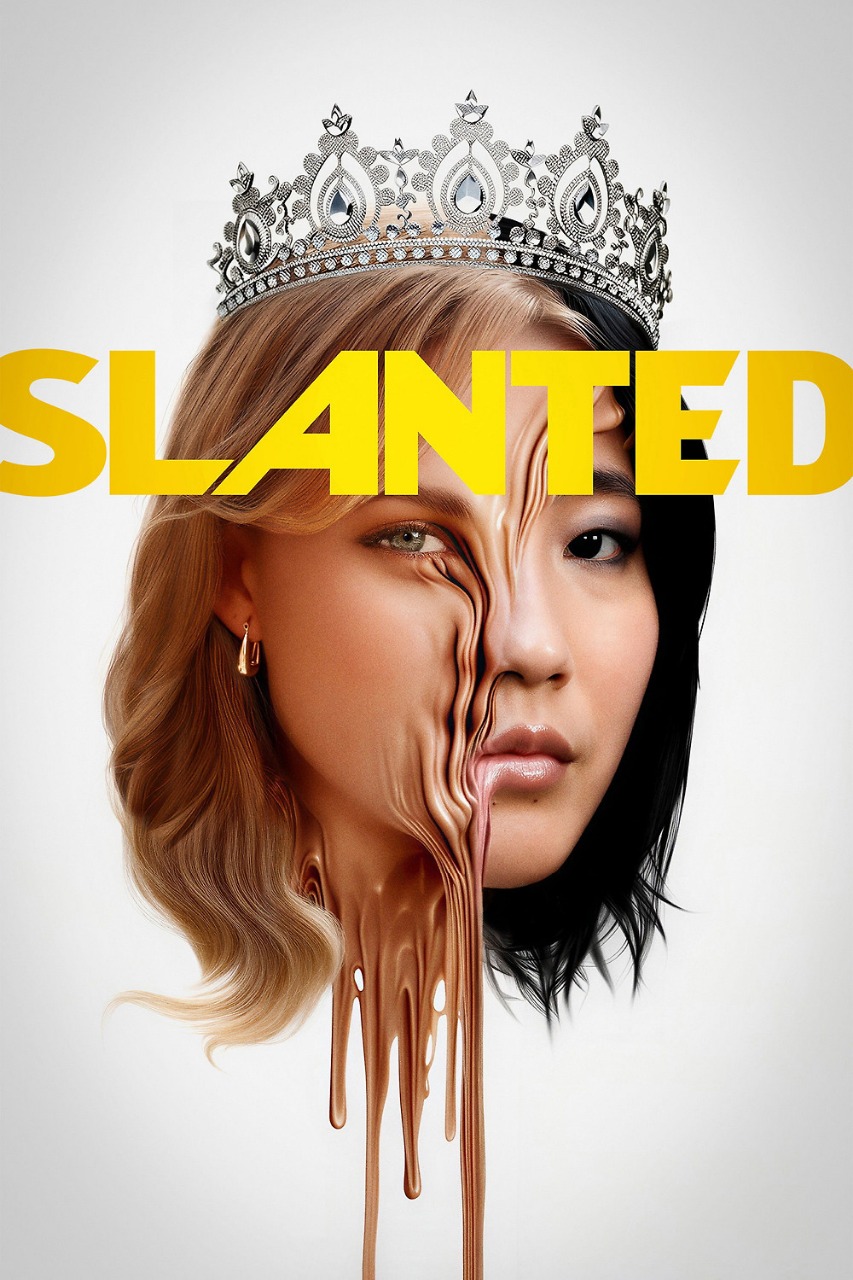 Film: Slanted
Year: 2025
Director: Amy Wang
Writer: Amy Wang
Starring: Shirley Chan, Mckenna Grace and Amelie Zilber
Review:
This was a film that I learned about by going to the Gateway Film Center. The trailer was showing so it went on a list of ones to check out. This being listed as a body horror film intrigued me. I did hear a local horror podcaster recommend this over another film. I’ll be honest, when I was looking through the titles playing, I originally forgot this was in genre. I did catch this at the theater. It is a 2026 wide release as well as a Voyage through the FiVes made its premiere in 2025.
Synopsis: an insecure Chinese American teenager undergoes experimental surgery to appear white, hoping to secure the prom queen title and peer acceptance.
We start this in a car where Roger Huang (Fang Du) drives. With him is his daughter Joan (Kristen Cui). She watches out the window, seeing the different billboards and businesses pushing their love for America. He takes her to school. It is there that she gets bullied for being different as her family is from China. Later that day, her mother is the one who picks her up, Sofia (Vivian Wu). As a family, they’re supposed to go to a festival but Roger has to work. Joan stays with him and wanders into the gym. They are having their prom and Joan is entranced.
It then shifts to Joan being in high school. She is now Shirley Chan. She wakes up and checks her phone to see that Olivia Hammond (Amelie Zilber), who is her classmate, won’t be going to prom. She just booked an acting job. Joan is stoked, thinking that it opens up the opportunity to become prom queen. The problem is she isn’t popular. Her best friend is Brindha (Maitreyi Ramakrishnan). Joan convinces her to help as a chance to stick it to the popular group.
Something to include here is that Joan’s parents work hard to give her a good life. Her father cleans houses, one of which belongs to Harmony (Elaine Hendrix). She has appropriated Asian culture with items in her home. Joan doesn’t want to be seen as Chinese American. She shuns being different and just wants to fit in. This saddens her mother, who wants to teach her a dumpling recipe that her mother taught her.
Joan then makes a drastic change. She dyes her hair blonde. It doesn’t come out perfectly, parts of it look orange and her roots are dark. This draws attention from Olivia and she invites her to get her nails done. The problem is that she and her friends use her to get a ‘locals’ discount as the salon is run by a Chinese woman. Joan feels used by the end of it.
That’s when she gets a special message. They have an offer to make her white. As a trial, they do a hair transplant to fix what she did. Willie Singer (R. Keith Harris) runs the clinic and reveals that he used to be Indian. In a desperate move, she tricks her mother into signing the consent forms since Joan isn’t 18 years old yet. This puts things into motion and truths to be revealed as Joan is now Jo Hunt (Mckenna Grace). Choices have consequences and there’s no going back.
That is where I’ll leave my recap and introduction to the characters. Where I want to start is by saying that this is exploring interesting ideas. I do believe that it goes too ham-fisted with how it handles it. I’m also not sure that it goes far enough into the genres that it is using. Something I haven’t had the chance to do would be check out why writer/director Amy Wang made this film. It is clear there are personal elements included and just knowing more would be beneficial since for me, it falls a bit short.
Now that I’ve set that up, let’s look at our lead character Joan. I’m not going to say that I can fully connect with her, since I’m a Caucasian male. Not completely fitting in is something that almost anyone can connect with. As a parent, it makes me cringe with how important she feels high school is. The farther away you get from that time in your life, how meaningless it becomes is something you can’t connect with until you have more life experiences. Joan currently believes winning prom queen is the pinnacle. She has hard lessons to learn here.
The back-and-forth between a loving couple and their daughter, Joan, reveals a key difference in their American experience. Sofia tells Jo about how she and Roger left China in their 30s, choosing not to assimilate but to define their own American identity. Joan, however, grew up in the US and, still searching for herself, made a life-altering shortcut. The text heavily critiques making such permanent decisions when young, arguing that youth should allow for reversible mistakes.
This decision then to go from Joan to Jo is interesting. It feels very Stepford Wives. This is driven home by Olivia and her friend group. Their ritual for lunch and how they all eat the same thing, with the exact containers is good imagery. I do like that Olivia has a reveal that I picked up on right before it did. There was a comment made earlier that made sense there. What I’ll say is Chen and Grace do well in mimicking each other to bring the character to life.
Let’s then explore other themes. Sticking with Joan's choice—a Faustian bargain for Western beauty standards—drives themes of body horror (through her change and attempt to reverse it) and generational disconnect (Joan vs. her immigrant parents). The satire is evident in the patriotic business names, including "Ethnos," the company responsible. Joan's best friend, Brindha, an Indian character, embraces her heritage, standing in contrast to Joan.
I next want to discuss acting performances. Chen and Grace excellently portrayed the same character with nuanced body language and mannerisms; credit is due to both. Wu and Du are great as her devastated but loving parents, a fitting arc. Zilber works, and her secret is intriguing. Her crew was the standard bland, popular group. Harris's role works; he's not a villain but not good. Cui and the rest of the cast rounded out the necessary roles.
All that is left would be the filmmaking aspects. In general, I think that they’re good. The cinematography and framing were solid. What I like, especially with Joan/Jo, is the collage on her wall of ‘beautiful’ white people. The torture she endures to fit in was good. When they go into body horror, it makes me cringe. They seemed to go practical with the effects which I like. We don’t get enough of that though. That is where my issue lies. Tonally this film incorporates a few different genres but doesn’t go far enough in any so it just feels off.
In conclusion, this presents a compelling, if occasionally heavy-handed, examination of assimilation, Western beauty standards, and generational conflict through the lens of body horror and satire. While Wang's direction shows a clear personal vision, the film's refusal to fully commit to any one genre—be it deep social commentary or visceral horror—leaves the final product feeling somewhat diluted. Chan and Grace deliver strong performances in embodying the conflicted protagonist's journey, making Slanted a memorable, if imperfect, cinematic exploration of the desperate measures taken in the search for belonging. It's a film that sparks conversation, even if it doesn't quite stick the landing on its ambitious thematic goals.
My Rating: 7 out of 10