Tags:
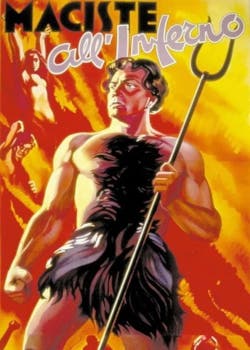 Film: Maciste in Hell (Maciste all'inferno)
Year: 1925
Director: Guido Brignone
Writers: Riccardo Artuffo, Stefano Pittaluga and Dante Alighieri
Starring: Bartolomeo Pagano, Umberto Guarracino and Mario Saio
Review:
This was a film that I learned about when compiling my master list of horror films from 1925 for my Centennial Club on my podcast, Journey with a Cinephile. This intrigued me since I’ve seen another early horror film from Italy where they explored the work of Dante Alighieri and his Divine Comedy. This an early film incorporating in the character of Maciste as well. Other than that, I wasn’t sure what we’d get here.
Synopsis: the devil takes Maciste (Bartolomeo Pagano) down to hell to corrupt and ruin his morality.
We get an early title card here stating that this story is told in 5 acts of devilry and fantasy. The first chapter is called ‘Between Earth and Hell’. This starts with Maciste sending demons back to where they came from. The current king of hell is Pluto (Umberto Guarracino). He is married to Proserpina (Elena Sangro) who is his second wife. He has a daughter from his previous marriage, Luciferina (Lucia Zanussi). Pluto won the last election to be the current king over Barbariccia (Franz Sala). He isn’t thrilled about this and binding his time. The other person here is Gerione (Mario Saio) who is the minister of internal affairs of hell.
It is from here that Pluto and Barbariccia come up with a plan to defeat Maciste. Demons are sent up in the guise of humans to corrupt him. They also want to spread evil across the city. There is an interesting thread here where Maciste’s neighbor, Graziella (Pauline Polaire), is interested in Giorgio (Domenico Serra). I get the idea that Maciste is in love with her, but she doesn’t reciprocate. It turns out that Giorgio took her innocence and she’s now pregnant. He has stopped communicating with her. Maciste doesn’t let this stand and pays him a visit to make him re-consider.
Then during the third act, Graziella has her baby and it is kidnapped by the demons. Maciste goes to save it. He is killed in the process and ends up in hell. It is there that Prosperina falls in love with him and wants to corrupt him. If he kisses her, whether it is of his own freewill or not, he will be damned. Barbariccia also sees his chance to overthrow Pluto and take over leadership. Maciste could be the deciding factor in who takes over, while he tries to find a way back to Earth.
That is where I’ll leave my recap and introduction to the characters. Where I want to start is that I’m not shocked this film is from Italy, being that Dante was Italian. This is borrowing heavily for things that we see in hell. Plus, there are even scenes that are taken directly from Dante’s Inferno from 1911. There is a section where we see the circle of hell that has frozen over with a giant Lucifer. They used aspects of that. I did smile there. Setting up the hierarchy of hell, where they have kings, government and it seems like elections are cool. There’s structure to the system and I find that interesting.
Now that I’ve set that up, this is the third or fourth Maciste film that I’ve seen. From the research that I’ve done, this mythical character is akin to a Heracles or Sampson where the name is interchangeable. What isn’t is that he’s a large, muscular man who does different feats and tends to take on supernatural forces. It is interesting since this character started in film back in 1914 when he was introduced. By this point, this is the 25th film that features the character. This is a series where I don’t think there’s much continuity between them though. He just goes on different adventures. Pagano is the original and he has been in all the silent era ones to this point. He has a good size and look, which is all you can ask for during this time.
What impressed me is going to take me back to discussing hell. I love the visuals there. I’m guessing part of that is borrowing from the source written by Dante. It also looks like it was inspired by Gustave Doré who did an illustrated novel. I’ll then pull in filmmaking and say that despite this being 100+ years old now, what they do to bring hell to life looks great. The sets have aspects of German Expressionism, which I’m also a fan of. It is nightmarish and is what I picture hell looking like. How they’re able to bring it to life is great. I’d also say that the look of the devil and demons is cool. I’m not going to spoil this outside of saying that we get an evil version of Maciste. That was a good touch. This is still limited due to when it was made, but the filmmaking techniques are amazing. I’m also not sure of what soundtrack should be synced up with this, but the version I watched added a good touch and helped the atmosphere.
All that would be left is talking about the rest of the cast. I’ve already credited Pagano as his size fits what I would expect for the character. Guarracino works as Pluto. He is limited though along with Saio and Sala. I did like how Zanussi and Sangro fall in love with Maciste. The former is purer, despite being a demon. The latter definitely is in lust with him. That also fit. Other than that, I did like the framing story to set the stage as well as come full circle with Polaire and Serra. Everyone is over the top, but that fits the silent era.
In conclusion, this one is a bit of a hidden gem from this era in my opinion. I love taking this legendary character of Maciste, then putting him in the middle of a war in hell. Exploring elements of the Divine Comedy and the hierarchy of hell piqued my interest. The filmmaking is impressive to be from this long ago. How they bring hell to life was great. The look of the demons is as well. This won’t be for everyone. If you are interested in exploring the history of horror like myself, then I’d recommend giving this a watch.
My Rating: 7 out of 10