
Tags:
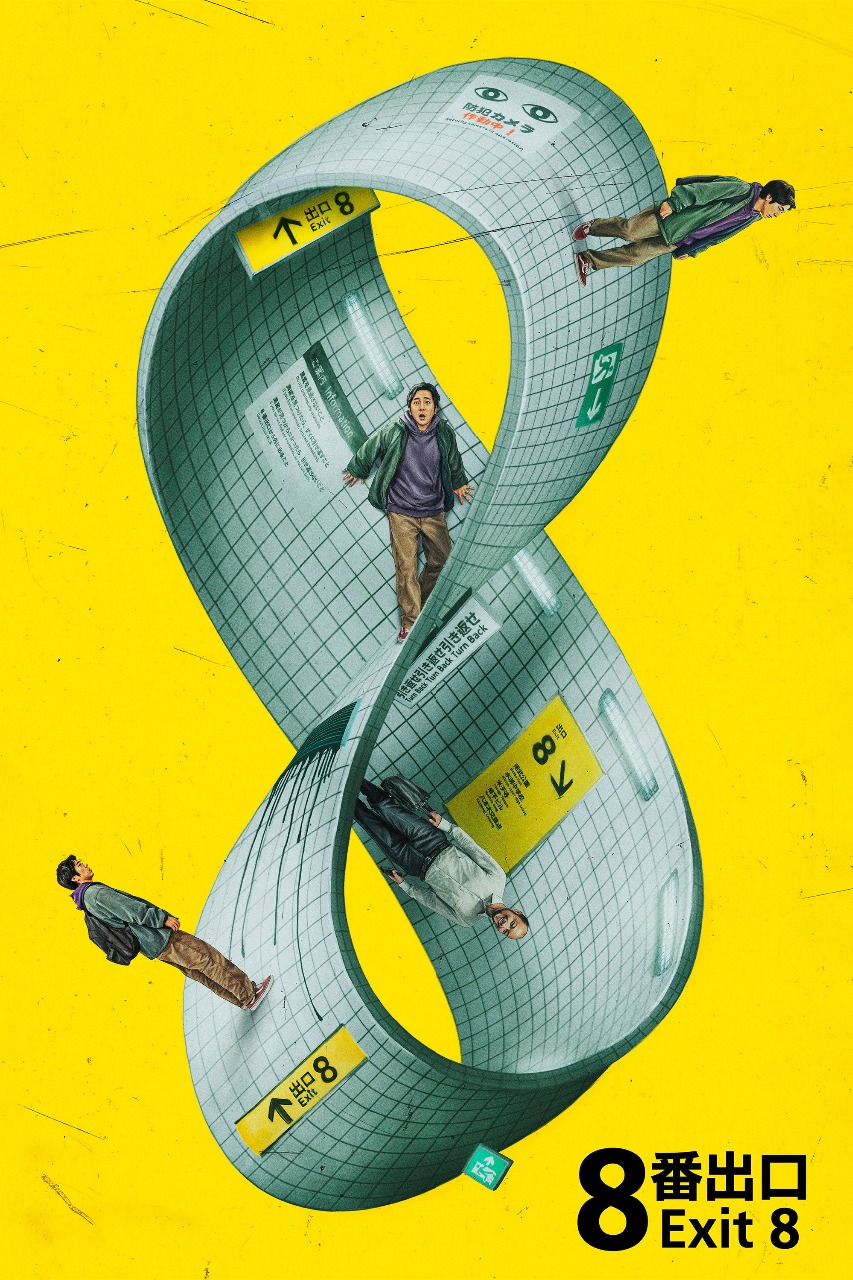 Film: Exit 8 (8-ban deguchi)
Year: 2025
Director: Genki Kawamura
Writers: Kentaro Hirase and Genki Kawamura
Starring: Kazunari Kinomiya, Yamato Kochi and Naru Asanuma
Review:
This was a film that I learned about from the trailers being shown at the Gateway Film Center. Once I realized what the title was and that this was in genre, I added it to my list of films to check out. This is for my 2026 end of year list. I was able to check this at the theater, but due to life and my schedule, it was during the following week of its release.
Synopsis: a man becomes increasingly desperate when he realizes he is trapped in a subway station, needing to complete a mission to get out.
We start this on a subway train. It is a POV shot. We are seeing through the eyes of Kazunari Ninomiya. He has his ear buds in and a phone call comes through. It is from Nana Komatsu. He ignores it. My first thought is because of the rules on the subway to be quiet. He then hears a baby crying. He looks over and sees a mother holding it. It is here that a business man goes off on her to quiet the child. Our lead ignores it and turns the music back on.
He then gets another call from the woman. This time he answers as he gets off the train. What we’ll learn is that our guy has a temp job. That’s where he’s going. The woman reveals that they used to date but are now broken up. She is at the hospital and it turns out, she’s pregnant. She wants his input and he’s indecisive. This sounds like an issue they also dealt with while they were dating. The man then tells her that he’ll tell his supervisor that he’s going to the hospital.
Trying to leave, he reaches Exit 8 and passes another man (Yamato Kochi). After rounding a corner with lockers and a photo booth, he finds a "Level 0" sign. The next corner leads back to the same hallway and the same man walking by. After several loops, he notices instructions at Level 0: he must spot anomalies—like flickering lights, altered posters, or the passing man—and turn back immediately. Any mistake resets his progress to zero.
It is from here that we refer to our lead as the Lost Man. There is the Walking Man and we follow him navigating this. His story starts after the Lost Man encounters a boy (Naru Asanuma), who at first he thinks is an anomaly. This is after he had a phone conversation with the Woman and he didn’t follow the rules. They aren’t sure how they became trapped here, but stress mounted as the littlest details are missed. If they ever want to break the cycle, they need to come to terms with decisions they’ve made that started these loops.
That is where I’ll leave my recap and introduction to the characters. Where I want to start is that I love the premise. Time loops are something that are fascinating as well as terrifying. In the case here, Exit 8 makes sense. An 8 looks like the infinity symbol, turned on its side. There are shades here of Cube for the fact that a pattern must be discovered. Very little information is given. There’s an intriguing concept here that the Walking Man isn’t as observant as the Lost Man. It is the Boy though, who is mostly ignored by the former who sees more than them both.
Now that I’ve set that up, I want to start with exploring the plight of our lead, The Lost Man. He must overcome his habit of coasting through life to escape the corridor. Scolded by the Woman for his indecision, he is haunted by his failure to defend the mother on the train. This regret manifests when a hallway door reveals his past self. The Boy further symbolizes his essential journey toward self-discovery.
Let’s examine the Walking Man and the Boy. Initially a recurring element for the Lost Man, the Walking Man is later seen exploring the loop where he passes the Schoolgirl (Kotone Hanase), suggesting she was trapped before him. Future captives will likely see the Lost Man trapped similarly. Unlike the observant Lost Man, this man’s aggressive decision-making leads him to miss details and ignore the Boy, whose story begins alongside him. How the Walking Man exits, is interesting when compared to the Lost Man as well.
Where I then want to go is when settling in to write this, it appears that it is based on a video game. It has me intrigued to see what this game would entail. While I was watching in the theater, I thought that it felt like a video game. From respawning and starting over until something is done correctly. There’s also an element of needing a ‘perfect run’ in order to ‘win’. That is something fun for a game, but not when you’re trapped so that adds a terrifying element.
Key themes include the horror of the mundane. Dread builds in a sterile, brightly lit hallway where uncanny "anomalies" foster paranoia and hyper-vigilance. Resetting progress after missing slight details is disheartening for the Lost Man. The film explores existential stagnation and urban isolation through an "in-between" reality, while strict rules turn the escape attempt into a Sisyphean labor.
The limited cast delivers strong performances. As the lead, Ninomiya effectively conveys mounting stress during the resets. His interaction with Asanuma is a highlight, as he utilizes the Boy’s attention to detail, which the Walking Man ignores. Kochi and Hanase excel as recurring figures, while Komatsu provides a haunting presence as the voice for the Lost Man. The supporting cast effectively rounds out the film.
Filmmaking-wise, the cinematography and framing effectively use a familiar setting to build tension. Although the Lost Man's initial confusion and the search for an escape are engaging, the repetitive concept occasionally drags across the 90-minute runtime. However, shifting focus and quality anomaly effects help mitigate this. Ultimately, the corridor's recurring theme successfully evokes a video game atmosphere.
In conclusion, this successfully translates the terrifying concept of an inescapable time loop into a cinematic experience, evoking the atmosphere of a video game that demands a "perfect run". The film leverages the horror of the mundane and themes of existential stagnation to frame the Lost Man's compelling journey of self-discovery, where he must overcome his chronic indecision to break the cycle. While the repetitive nature of the 90-minute runtime occasionally drags, the strong performances—particularly Ninomiya's portrayal of mounting stress—and the effective use of cinematography to build tension mitigate this issue. Ultimately, Exit 8 is a fascinating, if sometimes slow, dive into urban paranoia and a Sisyphean struggle for escape.
My Rating: 7 out of 10