Tags:
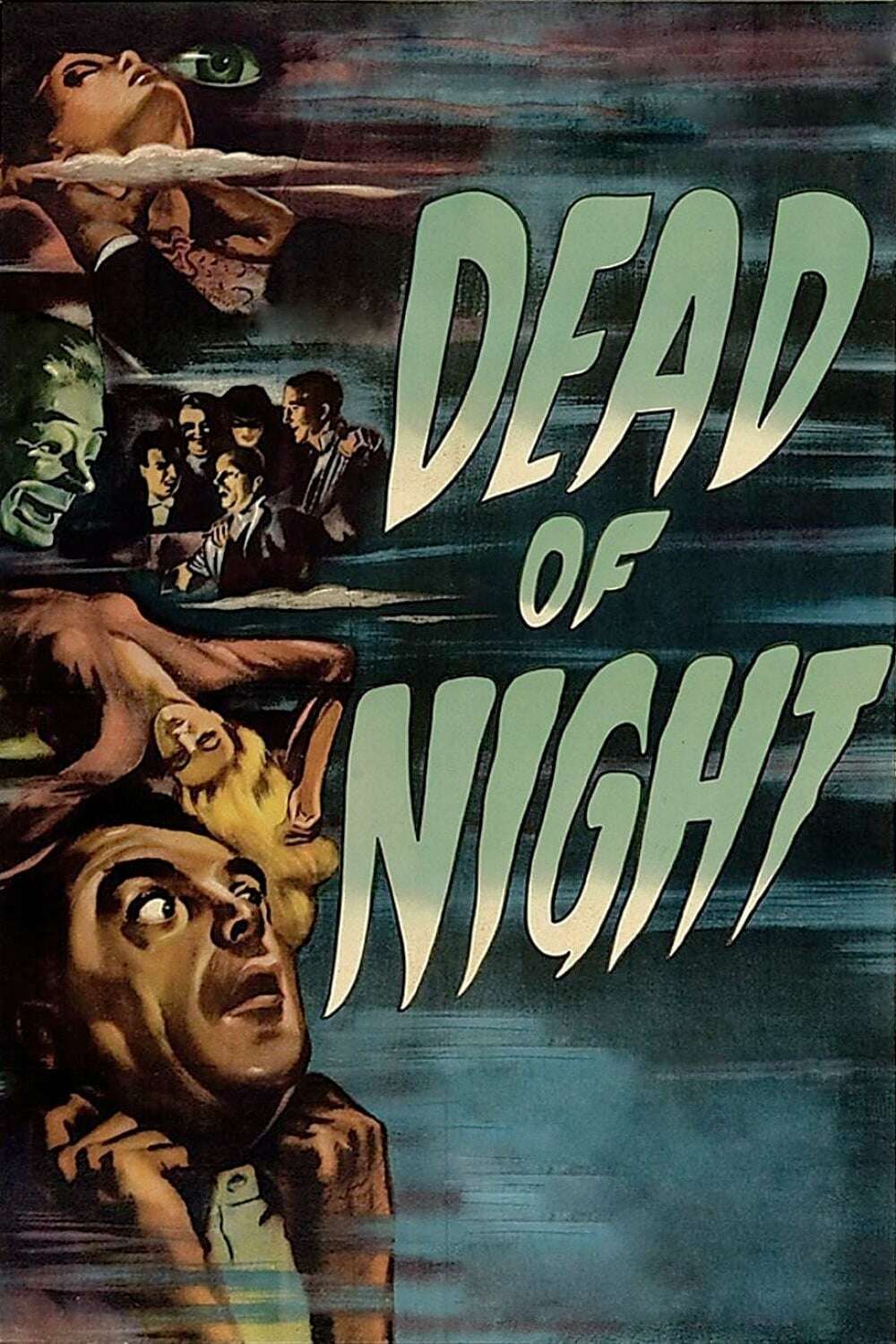 Film: Dead of Night
Year: 1945
Director: Alberto Cavalcanti, Charles Crichton, Basil Dearden and Robert Hamer
Writers: John Baines and Angus MacPhail
Starring: Mervyn Johns, Michael Redgrave and Roland Culver
Review:
This was a film that I’m not entirely sure about when I learned about it. My guess would be from its final story as this is an anthology movie. It also could have been through podcasts that it popped on my radar. Regardless, it went on my list of ones to see as I started working through my Voyage through the FiVes. It also doubled for multiple categories for HoopTober as well.
Synopsis: an architect, visiting an English country house, realizes the other guests are familiar from his recurring nightmare. When they share their tales of the supernatural, he is filled with a growing dread.
We start this with a car coming to the remote home from the synopsis. The driver is Walter Craig (Mervyn Johns). He’s uneasy and the reason we’ll learn is that his nightmare has come back to him. He’s met by Eliot Foley (Roland Culver). He lives here with his wife, Mrs. Foley (Mary Merrall). Walter is bothered because his dream has something bad happening to Dr. van Straaten (Frederick Valk), after his glasses break. The guests are intrigued and want to help him, because it is an odd thing he believes.
The other guests are Joan Cortland (Googie Withers), Hugh Grainger (Anthony Baird), Sally O’Hara (Sally Ann Howes) and Dr. van Straaten. He’s trying to figure out a scientific explanation to the story that Walter is telling. The other guests then go about telling their own touch with the supernatural.
Our first story then is from Hugh. He’s a race car driver who gets in a horrific accident. This lands him in hospital, but he’s miraculously not hurt. He does have a nurse that he develops a crush for, Joyce (Judy Kelly). As he’s approaching his release date, it comes into question when he hears something outside. He looks out the window to find a strange, horse drawn hearse. The driver, played by Miles Malleson, looks up and informs him that there’s room for one more. This comes back into play in a more terrifying way.
Sally then tells her story about a Christmas party at a mansion. The children play a variation on hide-and-seek. Sally hides in an obvious spot when another boy, Jimmy (Michael Allan) has her come to a room with him. It is there he tells her a story about two children who used to live here. There was a murder. Sally then might see specters of the people he brought up.
Our next story is then told from Joan. She purchases her husband Peter (Ralph Michael) an ornate antique mirror. He becomes obsessed and terrified of what he sees in it. Joan seeks out the history and learns of a terrifying similarity.
After that Eliot tells him about two rival golfers who compete over the love of a woman. When one cheats, the other makes a life altering decision to punish him. The final story before the conclusion of the wraparound is with Dr. van Straaten. A ventriloquist of Maxwell Frere (Michael Redgrave) is being held by police for assaulting another performer, Sylvester Kee (Hartley Power). Maxwell claims his dummy; Hugo is alive and that he’s innocent.
That is where I’ll leave my recap and introduction to the characters. Since each of these stories have a different director, I’ll break them down and then make a conclusion to summarize. I’ll then average my score on the shorts, with the wraparound being last.
Starting then with ‘Hearse Driver’. I thought that this one was perfectly paced. It doesn’t waste time getting Hugh into the hospital. I like Joyce coming back into play later as an element for the wraparound. This is spooky where Hugh sees this hearse driver. It’s a good touch that it is night when Hugh looks out the window, sees the hearse, it is day and the past. The contrast is a good move. This definitely has a ‘shock’ setup and punch when Hugh is out of the hospital and attempts to get on a trolley.
Basil Dearden and E.F. Beonson did a good job here with telling a complete story in limited time. I thought that after the set up to why we’re getting stories, this sets the stage well. They also are the writer and director of the wraparound, so that could also play into it. The cinematography and framing are good, especially like I said, the eerie part of looking out the window.
Moving over to the ‘Christmas Party’. This one from what I’ve read seems to be based on a true case. What is interesting though is that it seems more incidental. Sally is left in this room that appears to have been a bedroom or a playroom. The little boy doesn’t seem to be feeling well and his sister is domineering. Again, this is more about Sally encountering them and then when she talks about it, Jimmy wonders if she’s playing a trick on him.
What is curious is that I read that Universal, who distributed it in the United States, cut this story. This one does feel a bit rushed but I thought that it again has a ‘shock’ value. They introduce the elements quickly and to me, it tells a complete story. This was done by Alberto Cavalcanti and written by Angus MacPhail. I thought that the cinematography and framing were good. I love this large manor and having children play hide-and-seek. Not as good for creepiness but kept me interested to continue on for sure.
It is from here that it starts to go darker with ‘Haunted Mirror’. Joan purchases this as a gift. They get it hung and Peter looks into it. He sees a different room than the one that he’s in. He keeps seeing this which drives him mad. There is something terrifying about that. Joan does what she can to help him, which involves seeking out the dealer, played by Esme Percy. He reveals the former owner and his terrible past.
I do love stories like this. Peter is driven mad by this mirror. He then hides it, knowing that his wife thinks he’s being crazy. There’s a good element that she believes is enough to help him. That causes her to seek out the man she bought it from. I love that he finally just gives into staring into the mirror and what it does to his personality. Credit here to director Robert Hamer and writer John Baines. The cinematography and framing are once again great. This is paced well, tells a complete story and goes a bit darker than the previous two, which I appreciate.
That then takes us to the most whimsical of all the tales, ‘Golfing Story’. This has George Parratt (Basil Radford) and Larry Potter (Naunton Wayne), who are rivals on the course but best of friends. They both have fallen in love with Mary Lee (Peggy Bryan). She can’t choose between them so they play for her affection. One of them might have cheated to win and he’s then haunted by the other. It is funny what the specter does to punish his ‘friend’.
Like I said, this one does lean a bit more into the comedic. With what the previous story, the one after and how this wraps up, I don’t think this is a bad move. I had fun here. It is fitting because it does sound like this studio who made this film, focused more on comedies. Seeing what the ghost does to upset his friend is fun. This also seems like another story that was cut by Universal. I still think that it is well made. The cinematography and framing were good. If I have a gripe, this one does run a bit too long compared to the others for its pacing.
The final story before the wraparound is probably the most famous, ‘Ventriloquist’s Dummy’. I’ve read the source material, by Baines who also does this adaptation, earlier this year. This has Dr. van Straaten looking at the initial report and wanting to analyze Max. It then goes into telling the story of his successful act with Hugo. Sylvester came to the show and was quite impressed, also being a ventriloquist. Things get creepier when they run into each other again and Sylvester isn’t quite sure that Max is as good as he says as Hugo might be alive.
This is the best story by far. Seeing Max performing in the first set where he’s tottering on losing it is good. Max and Hugo are dynamite. It is after the show that makes you wonder, is Max insane and unable to turn it off. Or is there something more going on here? This is also directed by Cavalcanti. The cinematography and framing are great here, especially since it gets manic as Max goes deeper into his insanity. This runs a bit longer but warrants it to develop the characters.
I’ll then just end out with the wraparound. I love what they do here with Dr. van Straaten trying to figure out how to logically explain Walter’s issue. Things then go surreal from there. I won’t spoil it, but it is in line with exactly what he said earlier. That is good writing there and makes it feel like a precursor to The Twilight Zone. I also love that Joyce comes in, when prior to the stories starting, he said that an attractive, dark haired woman would come in. That helps with the foreboding atmosphere. The cinematography and framing were great here as well.
In conclusion, this is a classic anthology horror film that masterfully weaves together several tales of the supernatural with an overarching narrative that culminates in a truly unsettling climax. While some stories lean into dark comedy and others deliver genuine frights, the film consistently impresses with its strong direction, clever writing, and effective cinematography across its varied segments. The final, surreal twist of the wraparound story solidifies its place as a groundbreaking work that undoubtedly influenced future genre entries like The Twilight Zone, making it a must-see for fans of classic horror and psychological thrillers.
My Rating: 8 out of 10