Tags:
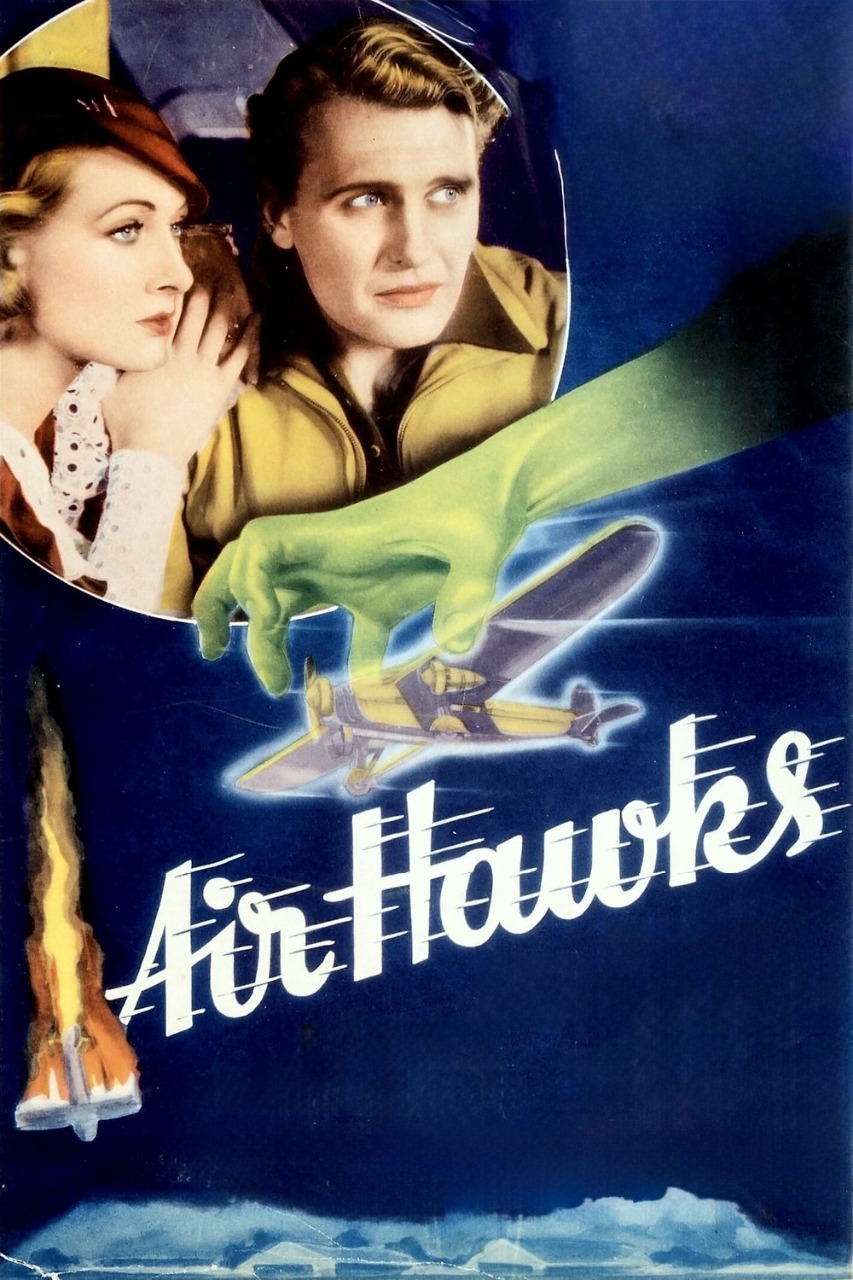 Film: Air Hawks
Year: 1935
Director: Albert S. Rogell
Writers: Grace Neville and Griffin Jay
Starring: Ralph Bellamy, Tala Birell and Victor Kilian
Review:
This was a film that I found when searching for horror from 1935. This was streaming on YouTube so that helped. My guess is that this is in the public domain. I made sure that I double check ahead of seeing that this is in genre. It is there on the Internet Movie Database, but not Letterboxd. That was good enough for me, so lining up that I had the correct film, I checked this out as a featured review for Journey with a Cinephile as a Voyage through the FiVes film.
Synopsis: a small, independent air delivery service is menaced by a mad scientist with a death ray machine that blows up planes in mid-flight.
Amidst a storm, pilot Frank Dunlap (Pat Flaherty) defies orders to return, completing his flight for Barry Eldon's (Ralph Bellamy) small airline. Barry is in the middle of a meeting, seeking a bank loan from Mr. Holden (Wyrley Birch). The funds are to secure a mail delivery contract, competing against a larger company that repeatedly tries to buy him out. Holden advises that Barry to consider the offer, deeming the loan too risky.
Barry brings the offer to his pilots who stick behind him. This inspires him to find another way. Out in the office is a newspaper reporter, Tiny Davis (Victor Kilian), who is trying to see Barry. Tiny follows out to the car but is left behind when a taxi breaks down, blocking them in. They are able to push it out of the way and Barry is smitten with the passenger, Renee Dupont (Tala Birell). He drives her to a hair salon and then sees her later at a club that she sings at.
Things that are happening here aren’t necessarily by chance. Renee seems to be a plant by Victor Arnold (Douglass Dumbrille) and his associate, Drewen (Robert Middlemass). They are the men who keep contacting Barry to buy him out. It seems they have numerous funds tied up and need this contract that Barry’s company is after. Renee is here to soften up Barry. It makes him turn down the offer to their face.
There is an alternative route that they can go. A Professor Schutter (Edward Van Sloan) has a prototype that he’s made for this ray that messes with the electrical system with whatever it is turned on to. His demonstration causes an airplane to explode. He needs money to build a larger version and he’s willing to use it to help this company if they provide the funds. Drewen is worried about the implications, but he along with Victor are forced to agree. The ray works better than either of them could imagine, bringing into question the equipment of Barry’s company.
That is where I’ll leave my recap and introduction to the characters. Now ahead of writing this, I glance at reviews on Letterboxd. The consensus is that this isn’t necessarily horror, even for the era it was made. I do agree there to an extent. We are getting more sci-fi with industrial espionage. It does go dark at times, especially with Frank and his family. If this was made today, it wouldn’t be in genre. Since it is listed on IMDb, I’m going to include it in my research.
Now that I have that out of the way, let’s delve into the main commentary that I see. This is an interesting look at capitalism. We’re seeing Barry’s company, which is smaller on the verge of landing a huge contract. He’s the little guy and doing exactly capitalistic system should. Because he doesn’t have the overhead and the work they do being as good as it is, he can undercut the larger company. They don’t like this and when they can’t buy him out, they turn to sabotage. I do like that at first, it seems like a couple of accidents. The newspapers start to believe that it is faulty equipment. Barry and his team know something is up, they just can’t prove it yet.
Sticking with the espionage angle, there is an interesting subplot with Renee and Barry. It isn’t a coincidence with what happens with her being stranded outside of his business. She’s there originally to get Barry to talk to Victor and Drewen. They’re giving him a chance to accept their offer being nefarious. Renee continues to factor in like Barry calling a number and recognizing her voice. She became a double agent of sorts and I thought that played into the story well. Birell fits as the ‘femme fatale’ archetype that would become more popular as the film noir sub-genre became more prominent. I believe it is still a bit early, so that puts it ahead of the time.
Then there’s these other aspects of the story to bring up. We get an early sci-fi horror film with this death ray that Prof. Schutter builds. He’s interesting as well as it seems he might have murdered co-workers and stolen the plans. There was sci-fi horror during this era, but it would get more popular in the 1950s. It is interesting that we’re seeing the emergence of commercial aviation here as well.
That should be enough there so let’s discuss the rest of the acting performances. Bellamy shines as the lead, fitting the role well, and his internal struggle adds depth. His pilots trust him to succeed. Birell effectively plays both sides. Kilian provides comic relief as a competent yet accident-prone reporter. Dumbrille, Middlemass, and the other villains are good, and Van Sloan is a fun mad scientist. All pilots, including Wiley Post (playing himself in a climax scene), deserve credit. Marianne Edwards' sad scene as Frank's daughter adds heart.
All that is left then is the filmmaking aspects. This shines here for what they do with filming the aerial scenes. There are real planes in action. I know that there are camera tricks to make it look more real. Credit there to the cinematography and framing. I do like the grounded approach to the effects with this death ray. It is more believable than other sci-fi based horror, especially from the era. The rest of the effects were limited, but work. The same goes for the soundtrack and design of the movie.
In conclusion, this offers a fascinating glimpse into 1930s filmmaking, blending early sci-fi elements with industrial espionage. While not a conventional horror film by modern standards, its exploration of corporate sabotage and scientific villainy provides a unique experience. The performances, particularly from Bellamy and Birell, contribute to a compelling narrative, and the aerial cinematography stands out for its realistic approach. Ultimately, this film is best suited for those with an appreciation for this particular era of cinema or if its intriguing blend of genres and themes sparks your interest.
My Rating: 6.5 out of 10